How to Get Dishwasher Clean Light to Come on Again
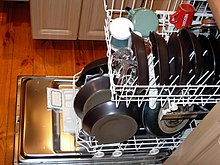
A dishwasher containing clean dishes

A dishwasher is a machine used to make clean dishware, cookware and cutlery automatically. Unlike manual dishwashing, which relies heavily on physical scrubbing to remove soiling, the mechanical dishwasher cleans by spraying hot water, typically between 45 and 75 °C (110 and 170 °F), at the dishes, with lower temperatures used for delicate items.[1]
A mix of h2o and dishwasher detergent is pumped to one or more rotating sprayers, cleaning the dishes with the cleaning mixture. The mixture is recirculated to save water and free energy. Often there is a pre-rinse, which may or may not include detergent, and the water is then drained. This is followed by the main wash with fresh water and detergent. One time the wash is finished, the water is drained, more than hot water enters the tub by means of an electro-mechanical solenoid valve, and the rinse cycle(south) brainstorm. After the rinse process finishes, the water is tuckered again and the dishes are dried using one of several drying methods. Typically a rinse-aid, a chemical to reduce surface tension of the water, is used to reduce h2o spots from hard water or other reasons.[2]
In addition to domestic units, industrial dishwashers are available for use in commercial establishments such every bit hotels and restaurants, where many dishes must be cleaned. Washing is conducted with temperatures of 65–71 °C (149–160 °F) and sanitation is achieved by either the use of a booster heater that will provide an 82 °C (180 °F) "final rinse" temperature or through the utilise of a chemical sanitizer.
History [edit]


A hand-powered dishwasher and an early electric dishwasher both from virtually 1917.
The first mechanical dishwashing device was registered for a patent in 1850 in the United States by Joel Houghton. This device was made of wood and was cranked past hand while h2o sprayed onto the dishes.[3] This device was both irksome and unreliable. Another patent was granted to L.A. Alexander in 1865 that was like to the first only featured a manus-cranked rack organisation.[4] Neither device was practical or widely accepted. Some historians cite as an obstacle to adoption the historical attitude that valued women for the endeavor put into housework rather than the results—making household chores easier was perceived past some to reduce their value.[5]
The most successful of the hand-powered dishwashers was invented in 1886 by Josephine Cochrane together with mechanic George Butters in Cochrane's tool shed in Shelbyville, Illinois[6] when Cochrane (a wealthy socialite) wanted to protect her china while it was being washed.[7] Her invention was unveiled at the 1893 World's Off-white in Chicago nether the proper name of Lavadora but was changed to Lavaplatos as another machine invented in 1858 already held that name. Cochrane's inspiration was her frustration at the damage to her good communist china that occurred when her servants handled it during cleaning.[8]

Advertisement in an 1896 effect of McClure's for The Faultless Quaker Dishwasher.
Europe's showtime domestic dishwasher with an electric motor was invented and manufactured by Miele in 1929.[nine] [ten]
In the U.k., William Howard Livens invented a small, not-electric dishwasher suitable for domestic use in 1924. It was the first dishwasher that incorporated most of the design elements that are featured in the models of today;[11] it included a front end door for loading, a wire rack to agree the dirty crockery and a rotating sprayer. Drying elements were even added to his design in 1940. Information technology was the kickoff machine suitable for domestic use, and it came at a time when permanent plumbing and running h2o in the house was condign increasingly common.[12] [thirteen]
Despite this, Liven'south design did non become a commercial success, and dishwashers were only successfully sold as domestic utilities in the postwar nail of the 1950s, albeit only to the wealthy. Initially, dishwashers were sold as standalone or portable devices, but with the evolution of the wall-to-wall countertop and standardized height cabinets, dishwashers began to be marketed with standardized sizes and shapes, integrated underneath the kitchen countertop as a modular unit of measurement with other kitchen appliances.
By the 1970s, dishwashers had become commonplace in domestic residences in North America and Western Europe. By 2012, over 75 percent of homes in the U.s. and Germany had dishwashers.[fourteen]
In the late 1990s, manufacturers began offer various new energy conservation features in dishwashers.[15] One feature was utilise of "soil sensors", which was a computerized tool in the dishwasher which measured nutrient particles coming from dishes.[15] When the dishwasher had cleaned the dishes to the signal of non releasing more food particles, so the soil sensor would report the dishes existence cleaned.[15] The sensor operated with another innovation of using variable washing time.[xv] If dishes were especially muddy, and so the dishwasher would run for a longer fourth dimension than if the sensor detected them to be clean. In this way, the dishwasher saves energy and water by simply being in operation for as long as needed.[15]
Pattern [edit]
Size and chapters [edit]

North American counter-superlative dishwasher
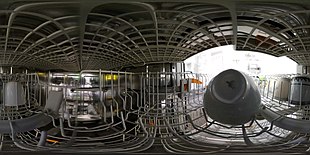
Dishwashers that are installed into standard kitchen cabinets have a standard width and depth of 60 cm (Europe) or 24 in (61 cm) (Us), and most dishwashers must exist installed into a pigsty a minimum of 86 cm (Europe) or 34 in (86 cm) (United states) tall. Portable dishwashers exist in 45 and 60 cm (Europe) or 18 and 24 in (46 and 61 cm) (Usa) widths, with casters and attached countertops. There are too dishwashers available in sizes according to the European gastronorm standard. Dishwashers may come in standard or tall tub designs; standard tub dishwashers have a service kickplate below the dishwasher door that allows for simpler maintenance and installation, merely tall tub dishwashers have approximately 20% more capacity and better sound dampening from having a continuous front end door.
The international standard for the capacity of a dishwasher is expressed as standard place settings. Commercial dishwashers are rated as plates per hr. The rating is based on standard-sized plates of the aforementioned size. The same tin be said for commercial drinking glass washers, as they are based on standard glasses, normally pint spectacles.
Layout [edit]
Present-mean solar day machines characteristic a drop-downward front console door, assuasive access to the interior, which usually contains two or sometimes three pull-out racks; racks tin can as well be referred to as "baskets". In older U.S. models from the 1950s, the entire tub rolled out when the machine latch was opened, and loading besides as removing washable items was from the top, with the user reaching deep into the compartment for some items. Youngstown Kitchens, which manufactured entire kitchen cabinets and sinks, offered a tub-style dishwasher, which was coupled to a conventional kitchen sink equally one unit. About present-day machines permit for placement of dishes, silverware, tall items and cooking utensils in the lower rack, while glassware, cups and saucers are placed in the upper rack. One notable exception were dishwashers produced by the Maytag Corporation from the late sixties until the early nineties. These machines were designed for loading glassware, cups and saucers in the lower rack, while plates, silverware, and alpine items were placed into the upper rack. This unique blueprint allowed for a larger capacity and more flexibility in loading of dishes and pots and pans. Today, "dish drawer" models eliminate the inconvenience of the long reach that was necessary with older total-depth models. "Cutlery baskets" are also common. A drawer dishwasher, first introduced by Fisher & Paykel in 1997, is a variant of the dishwasher in which the baskets slide out with the door in the same manner as a drawer filing cabinet, with each drawer in a double-drawer model being able to operate independently of the other.
The inside of a dishwasher in the North American market is either stainless steel or plastic. Most of them are stainless steel body and plastic made racks. Stainless steel tubs resist hard h2o, and preserve heat to dry out dishes more quickly. They also come at a premium cost. Dishwashers can be bought for as expensive equally $ane,500+, but countertop dishwashers are also available for under $300. Older models used broiled enamel tubs, while some used a vinyl coating bonded to a steel tub, which provided protection of the tub from acidic foods and provided some sound attenuation. European-made dishwashers characteristic a stainless steel interior equally standard, fifty-fifty on depression-finish models. The same is true for a born h2o softener.
Washing elements [edit]
European dishwashers almost universally utilise two or three sprayers which are fed from the bottom and back wall of the dishwasher leaving both racks unimpeded and also such models tend to apply inline water heaters, removing the need for exposed elements in the base of operations of the machine that tin can melt plastic items near to them. Many N American dishwashers tend to use exposed elements in the base of the dishwasher. Some North American machines, primarily those designed by General Electrical, employ a wash tube, often called a wash-tower, to direct water from the bottom of the dishwasher to the top dish rack. Some dishwashers, including many models from Whirlpool and KitchenAid, use a tube fastened to the top rack that connects to a water source at the dorsum of the dishwasher and directs h2o to a second wash spray beneath the upper rack, this allows full utilize of the lesser rack. Late-model Frigidaire dishwashers shoot a jet of water from the top of the washer down into the upper launder sprayer, again allowing total use of the bottom rack (but requiring that a small funnel on the top rack be kept articulate).
Features [edit]
Clear model of a running dishwasher
Mid- to higher-stop North American dishwashers ofttimes come with difficult nutrient disposal units, which behave like miniature garbage (waste product) disposal units that eliminate large pieces of food waste material from the wash water. 1 manufacturer that is known for omitting difficult nutrient disposals is Bosch, a German brand; however, Bosch does then in guild to reduce dissonance. If the larger items of food waste material are removed before placing in the dishwasher, pre-rinsing is not necessary even without integrated waste disposal units.
Many new dishwashers feature microprocessor-controlled, sensor-assisted launder cycles that conform the wash duration to the number of dingy dishes (sensed by changes in water temperature) or the corporeality of dirt in the rinse water (sensed chemically or optically). This tin salve water and energy if the user runs a partial load. In such dishwashers the electromechanical rotary switch frequently used to control the washing bicycle is replaced by a microprocessor, but most sensors and valves are still required. However, pressure switches (some dishwashers utilize a pressure switch and menstruum meter) are non required in most microprocessor controlled dishwashers every bit they use the motor and sometimes a rotational position sensor to sense the resistance of water; when information technology senses there is no cavitation information technology knows information technology has the optimal corporeality of water. A bimetal switch or wax motor opens the detergent door during the wash cycle.
Some dishwashers include a child-lockout feature to prevent adventitious starting or stopping of the wash cycle by children. A kid lock can sometimes be included to forbid young children from opening the door during a wash bicycle. This prevents accidents with hot water and strong detergents used during the launder wheel.
Process [edit]
Energy employ and water temperatures [edit]
In the European union, the energy consumption of a dishwasher for a standard usage is shown on a European Spousal relationship energy label. In the United States, the energy consumption of a dishwasher is divers using the energy factor.
Almost consumer dishwashers use a 75 °C (167 °F) thermostat in the sanitizing process. During the concluding rinse cycle, the heating chemical element and wash pump are turned on, and the cycle timer (electronic or electromechanical) is stopped until the thermostat is tripped. At this signal, the cycle timer resumes and will by and large trigger a drain bicycle within a few timer increments.
Nigh consumer dishwashers use 75 °C (167 °F) rather than 83 °C (181 °F) for reasons of burn hazard, energy and water consumption, full bike time, and possible damage to plastic items placed inside the dishwasher. With new advances in detergents, lower water temperatures (50–55 °C / 122–131 °F) are needed to prevent premature decay of the enzymes used to eat the grease and other build-ups on the dishes.
In the US, residential dishwashers tin can exist certified to a NSF International testing protocol which confirms the cleaning and sanitation functioning of the unit.[16]
Drying [edit]
The heat within the dishwasher dries the contents after the final hot rinse. Northward American dishwashers tend to employ heat-assisted drying via an exposed element which tends to be less efficient. European machines and some high end Northward American machines employ passive methods for drying – a stainless steel interior helps this process and some models use heat commutation technology betwixt the inner and outer skin of the machine to cool the walls of the interior and speed upwardly drying. Some dishwashers employ desiccants such as zeolite which at the kickoff of the wash are heated, dry out and creating steam which warms plates, and and then are cooled during the dry cycle which absorbs moisture again, saving significant energy.
Plastic and non-stick items form drops with smaller surface surface area[17] and may non dry properly compared to china and glass, which also store more than heat that meliorate evaporate the piddling water that remains on them. Some dishwashers incorporate a fan to better drying. Older dishwashers with a visible heating element (at the bottom of the wash cabinet, beneath the bottom handbasket) may use the heating element to ameliorate drying; still, this uses more than free energy.
Most importantly nonetheless, the concluding rinse adds a pocket-sized amount of rinse-aid to the hot water, this is a mild detergent that improves drying significantly past reducing the inherent surface tension of the water so that water mostly drips off, greatly improving how well all items, including plastic items, dry.
About dishwashers feature a drying sensor and as such, a dish-washing cycle is always considered complete when a drying indicator, normally in the class of an illuminated "end" light, or in more modern models on a digital display or audible sound, exhibits to the operator that the washing and drying cycle is now over.
U.s. Governmental agencies oftentimes recommend air-drying dishes by either disabling or stopping the drying bike to save energy.[18]
Differences betwixt dishwashers and mitt washing [edit]
Dishwasher detergent [edit]
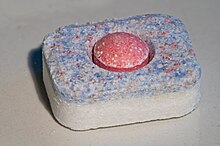
Dishwashers are designed to piece of work using specially formulated dishwasher detergent. Over time, many regions have banned the use of phosphates in detergent and phosphorus-based compounds. They were previously used because they have properties that assistance in effective cleaning. The concern was the increase in algal blooms in waterways caused by increasing phosphate levels (see eutrophication).[19] Seventeen Us states have partial or full bans on the use of phosphates in dish detergent,[20] and two Us states (Maryland and New York) ban phosphates in commercial dishwashing. Detergent companies claimed it is non cost effective to make separate batches of detergent for the states with phosphate bans, and so most have voluntarily removed phosphates from all dishwasher detergents.[21]
In addition, rinse aids accept contained nonylphenol and nonylphenol ethoxylates. These accept been banned in the European Matrimony past EU Directive 76/769/EEC.
In some regions depending on water hardness a dishwasher might role better with the employ of a dishwasher salt.
Glassware [edit]
Glassware washed by dishwashing machines can develop a white haze on the surface over fourth dimension. This may be acquired past whatsoever or all of the beneath processes, of which only the first is reversible:
- Degradation of minerals
- Calcium carbonate (limescale) in hard water can deposit and build up on surfaces when water dries. The deposits tin exist dissolved by vinegar or another acid. Dishwashers often include ion commutation device to remove calcium and magnesium ions and supersede them with sodium. The resultant sodium salts are water soluble and don't tend to build up.
- Silicate filming, carving, and accelerated crack corrosion
- This pic starts equally an iridescence or "oil-film" effect on glassware, and progresses into a "milky" or "cloudy" appearance (which is not a eolith) that cannot be polished off or removed like limescale. It is formed because the detergent is strongly alkaline (bones) and glass dissolves slowly in element of group i aqueous solution. It becomes less soluble in the presence of silicates in the water (added as anti-metal-corrosion agents in the dishwasher detergent). Since the cloudy appearance is due to nonuniform glass dissolution, it is (somewhat paradoxically) less marked if dissolution is higher, i.e. if a silicate-free detergent is used; too, in certain cases, the etching will primarily be seen in areas that have microscopic surface cracks as a event of the items' manufacturing.[22] [23] Limitation of this undesirable reaction is possible past controlling water hardness, detergent load and temperature. The type of drinking glass is an of import factor in determining if this result is a problem. Some dishwashers can reduce this carving event past automatically dispensing the right amount of detergent throughout the wash cycle based on the level of water hardness programmed.
- Dissolution of lead
- Atomic number 82 in atomic number 82 crystal tin be converted into a soluble form past the loftier temperatures and strong alkali detergents of dishwashers, which could endanger the health of subsequent users.[24]
Other materials [edit]
Other materials as well drinking glass are also harmed past the potent detergents, stiff agitation, and high temperatures of dishwashers, especially on a hot wash cycle when temperatures can reach 75 °C (167 °F).[25] Aluminium, contumely, and copper items will discolor, and lite aluminum containers volition mark other items they knock into. Nonstick pan coatings will deteriorate. Sleeky, gilt-colored, and hand-painted items will be dulled or fade. Fragile items and sharp edges will be dulled or damaged from colliding with other items or thermal stress. Sterling silver and pewter volition oxidize and discolour from the oestrus and from contact with metals lower on the galvanic serial such as stainless steel.[26] Pewter has a depression melting indicate and may warp in some dishwashers. Glued items, such every bit hollow-handle knives or wooden cutting boards, will melt or soften in a dishwasher; loftier temperatures and moisture damage wood. High temperatures damage many plastics, particularly in the bottom rack close to an exposed heating chemical element (many newer dishwashers have a curtained heating element away from the bottom rack entirely). Squeezing plastic items into minor spaces may cause the plastic to misconstrue in shape. Cast atomic number 26 cookware is normally seasoned with oil or grease and heat, which causes the oil or grease to exist absorbed into the pores of the cookware, thereby giving a polish relatively not-stick cooking surface which is stripped off by the combination of brine based detergent and hot water in a dishwasher.
Knives and other cooking tools that are made of carbon steel, semi-stainless steels like D2, or specialized, highly hardened cutlery steels like ZDP189 corrode in the extended wet bath of dishwashers, compared to briefer baths of hand washing. Cookware is made of austenitic stainless steels, which are more stable.
Items contaminated by chemicals such every bit wax, cigarette ash, poisons, mineral oils, moisture paints, oiled tools, furnace filters, etc. can contaminate a dishwasher, since the surfaces inside pocket-size h2o passages cannot be wiped make clean every bit surfaces are in hand-washing, so contaminants remain to bear on future loads. Objects contaminated by solvents may explode in a dishwasher.
Environmental comparison [edit]
Dishwashers use less water, and therefore less fuel to oestrus the water, than hand washing, except for small quantities done in wash bowls without running water.[27] [28]
Mitt-washing techniques vary past individual. According to a peer-reviewed study in 2003, mitt washing and drying of an corporeality of dishes equivalent to a fully loaded automatic dishwasher (no cookware or bakeware) could apply between 20 and 300 litres (v.three and 79.three US gal) of water and between 0.1 and 8 kWh of free energy, while the numbers for energy-efficient automatic dishwashers were 15–22 litres (4.0–v.8 US gal) and 1 to two kWh, respectively. The report concluded that fully loaded dishwashers use less energy, h2o, and detergent than the average European hand-washer.[29] [30] For the automatic dishwasher results, the dishes were non rinsed before beingness loaded. The study does not address costs associated with the manufacture and disposal of dishwashers, the cost of possible accelerated wear of dishes from the chemical harshness of dishwasher detergent, the comparing for cleaning cookware, or the value of labour saved; paw washers needed between 65 and 106 minutes. Several points of criticism on this study take been raised.[31] For example, kilowatt hours of electricity were compared against free energy used for heating hot water without taking into account possible inefficiencies. Also, inefficient handwashings were compared confronting optimal usage of a fully loaded dishwasher without transmission pre-rinsing that can take up to 100 litres (26 US gal) of h2o.[32]
A 2009 study showed that the microwave and the dishwasher were both more effective ways to clean domestic sponges than handwashing.[33]
Adoption [edit]
Commercial use [edit]
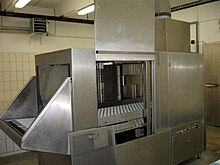
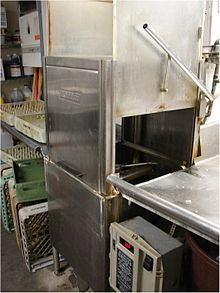
A Hobart commercial dishwasher
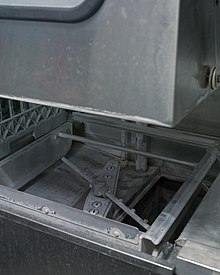
Inside of the commercial dishwasher.
Large heavy-duty dishwashers are available for use in commercial establishments (e.g. hotels, restaurants) where many dishes must be cleaned.
Different a residential dishwasher, a commercial dishwasher does non utilise a drying bicycle (commercial drying is achieved by heated ware coming together open up air once the wash/rinse/sanitation cycles accept been completed) and thus are significantly faster than their residential counterparts. Washing is conducted with 65–71 °C / 150–160 °F temperatures and sanitation is achieved by either the use of a booster heater that volition provide the machine 82 °C / 180 °F "final rinse" temperature or through the use of a chemical sanitizer. This stardom labels the machines as either "high-temp" or "low-temp".[34]
Some commercial dishwashers work similarly to a commercial car launder, with a caster organization that pulls the rack through a small chamber (known widely equally a "rack conveyor" systems). Single-rack washers require an operator to push the rack into the washer, close the doors, start the cycle, and and so open up the doors to pull out the cleaned rack, possibly through a second opening into an unloading expanse.
In the United kingdom of great britain and northern ireland, the British Standards Institution gear up standards for dishwashers. In the US, NSF International (an independent not-for-profit system) sets the standards for wash and rinse time along with minimum water temperature for chemic or hot-water sanitizing methods.[35] There are many types of commercial dishwashers including under-counter, single tank, conveyor, flight type, and carousel machines.
Commercial dishwashers oftentimes accept significantly unlike plumbing and operations than a dwelling house unit of measurement, in that there are often dissever sprayers for washing and rinsing/sanitizing. The launder h2o is heated with an in-tank electric rut element and mixed with a cleaning solution, and is used repeatedly from one load to the next. The wash tank usually has a large strainer basket to collect nutrient debris, and the strainer may not be emptied until the terminate of the day's kitchen operations.
H2o used for rinsing and sanitizing is generally delivered straight through building water supply, and is not reusable. The used rinse water empties into the wash tank reservoir, which dilutes some of the used wash h2o and causes a small amount to drain out through an overflow tube. The system may first rinse with pure water simply and so sanitize with an additive solution that is left on the dishes as they leave the washer to dry out.
Additional soap is periodically added to the main launder h2o tank, from either large soap concentrate tanks or dissolved from a big solid soap block, to maintain wash water cleaning effectiveness.
Alternative uses [edit]
Dishwashers tin can be used to cook foods at low temperatures (e.m. dishwasher salmon).[36] [37] The foods are generally sealed in canning jars or oven bags since even a dishwasher cycle without soap can eolith residual lather and rinse aid from previous cycles on unsealed foods.[38]
Dishwashers as well have been documented to exist used to clean potatoes, other root vegetables, garden tools, sneakers or trainers, silk flowers,[39] some sporting goods, plastic hairbrushes, baseball caps, plastic toys, toothbrushes, flip-flops,[forty] contact lens cases, a mesh filter from a range hood, fridge shelves and bins,[41] toothbrush holders, pet bowls and pet toys.[42] Cleaning vegetables and plastics is controversial since vegetables can be contaminated by soap and rinse assist from previous cycles and the oestrus of about standard dishwashers can cause BPA or phthalates to leach out of plastic products.[38] The apply of a dishwasher to clean greasy tools and parts is not recommended equally the grease can clog the dishwasher.[38]
Come across also [edit]
- Home appliance
- Washing machine
References [edit]
- ^ Özçevik, Ö; Brebbia, C. A.; Şener, S. M. (2015). Sustainable Development and Planning VII. WIT Press. p. 794. ISBN978-1845649241.
- ^ Zoller, Uri (2008). Handbook of Detergents, Part E: Applications. CRC Press. pp. 60–62. ISBN978-1574447576.
- ^ U.South. Patent 7,365
- ^ U.Southward. Patent 51000A
- ^ "What Does It Take To Get Us To Try Something New?". The Indicator from Planet Money. NPR. 26 May 2021.
- ^ U.S. Patent 355,139
- ^ Blattman, Elissa (2013), Three Every-day Items Invented by Women, National Women's History Museum
- ^ "Josephine Cochrane | Lemelson-MIT Plan".
- ^ Nick Kochan (25 November 1996). The World'due south Greatest Brands. Palgrave Macmillan UK. pp. 111–. ISBN978-1-349-14114-2.
- ^ Tina Gant (30 September 2003). International Directory of Company Histories. St. James Press. ISBN978-i-55862-486-3.
- ^ "Made in the United kingdom of great britain and northern ireland: The life-changing everyday innovations which put British genius on the map". Daily Mirror. September 2012.
- ^ "Archive Gallery: Kitchens of the Incredible 1950s Future". Pop Science . Retrieved 27 Oct 2014.
- ^ William Howard Livens (1924-x-23). "Improvements in apparatus for washing household crockery and the like". FR579765. UK Intellectual Property Role. Retrieved 2008-03-04 .
- ^ "The History of the Dishwasher". Yellow Advertiser. Archived from the original on 2014-02-17. Retrieved 2013-eleven-02 .
- ^ a b c d eastward Janeway, Kimberly (9 December 2016). "v Things to Know When Replacing a Dishwasher". Consumer Reports . Retrieved 20 March 2017.
- ^ "NSF Consumer Information: Residential Appliances and Other Products for the Home". Nsf.org. Retrieved 2022-01-03 .
- ^ "Curiosities: Why does plastic dry slower than glass?".
- ^ "Acme 10 Tips for Renters: ENERGY STAR". Energystar.gov. Retrieved 2012-06-20 .
- ^ Kogawa, Ana Carolina; Cernic, Beatriz Gamberini; exercise Couto, Leandro Giovanni Domingos; Salgado, Hérida Regina Nunes (February 2017). "Synthetic detergents: 100 years of history". Saudi Pharmaceutical Journal. 25 (6): 934–938. doi:10.1016/j.jsps.2017.02.006. PMC5605839. PMID 28951681.
- ^ "Doc. Dish Lather Beak Might Help Make clean Bay". Washingtonpost.com. 2007-03-03. Retrieved 2012-06-20 .
- ^ "Phosphate Complimentary Dishwasher Detergent Leaves Dishes Dirty". GE Appliances. Retrieved 2013-xi-30 .
- ^ "Lehigh-Unilever report sheds calorie-free on mystery of cloudy wineglasses". Scienceblog.com. Archived from the original on 2006-10-22. Retrieved 2012-06-20 .
- ^ Sharma, Anju; Jain, Himanshu; Carnali, Joseph O.; Lugo, Guillermo Manuel (2003). "Influence of the Manufacturing Procedure on Corrosion Behavior of Soda-Lime-Silicate Glassware". Journal of the American Ceramic Guild. 86 (10): 1669–1676. doi:x.1111/j.1151-2916.2003.tb03538.x. Archived from the original on 2012-11-07. Retrieved 2010-06-09 .
- ^ "Lead Contamination In Our Environment". Yale.edu. Retrieved 2012-06-xx .
- ^ Strutner, Suzy (2015-05-07). "You lot Should Pretty Much NEVER Wash Your Dishes Past Mitt. Hither'due south Why". Huffington Post . Retrieved 2017-12-30 .
- ^ "Dishwashing Secrets". Martha Stewart. 2011-02-02. Retrieved 2017-12-30 .
- ^ Mooney, Chris (2015-05-05). "Why y'all shouldn't wash your dishes by hand". Washington Post . Retrieved 2017-12-30 .
- ^ "Dishwasher vs. Hand Washing Dishes". www.energystar.gov . Retrieved 2017-12-thirty .
- ^ Stamminger, Rainer (2003). "A European Comparison of Cleaning Dishes by Hand". Proceedings of EEDAL Conference . Retrieved 2010-06-13 .
- ^ Stamminger, Rainer (May–June 2004). "Is a machine more than efficient than the hand?" (PDF). Domicile Energy. Archived from the original (PDF) on 2015-07-01. Retrieved 2010-06-thirteen .
- ^ Dishwashing: man vs. machine. Yoram Gat, Pro Bono Statistics Weblog (2008)
- ^ Dishwashing and Water Conservation: An Opportunity for Environmental Education Archived 2013-08-01 at the Wayback Machine. Periodical of Extension, Volume 41, Number ane (2003).
- ^ Taché, J.; Carpentier, B. (2014). "Hygiene in the home kitchen: Changes in behaviour and impact of cardinal microbiological risk control measures". Food Control. 35: 392–400. doi:x.1016/j.foodcont.2013.07.026.
- ^ "Comparing High Temp vs. Depression Temp Commercial Dishwashers". www.acitydiscount.com. Archived from the original on 2020-09-24. Retrieved 2021-10-28 .
- ^ "NSF commodity on dishwashers". Nsf.org. Archived from the original on 2012-05-22. Retrieved 2012-06-xx .
- ^ "Dishwasher Cooking: Brand Your Dinner While Cleaning The Plates". National Public Radio. 2013-08-25. Retrieved 2018-12-xx .
- ^ Lisa., Casali (2011). Cucinare in lavastoviglie : gusto, sostenibilità e risparmio con un metodo rivoluzionario. Milano: Gribaudo. ISBN9788858004340. OCLC 898508940.
- ^ a b c Kimbleton, Nikki (2018-08-13). "Things you should never put in the dishwasher". Consumer Reports . Retrieved 2018-12-20 .
- ^ "Did you know your dishwasher could do this?!". NBC . Retrieved 2018-12-xx .
- ^ "The best way to load your dishwasher". The Good Housekeeping Institute. 2017-05-10. Retrieved 2018-12-xx .
- ^ "Yes, you tin wash golf balls in the dishwasher (and other surprising things)". NBC . Retrieved 2018-12-20 .
- ^ Herman, Valli. "Turns out your kitchen (not the bathroom!) is the grossest identify in the firm". Retrieved 2018-12-xx .
External links [edit]
- "How Dishwashers Work" at HowStuffWorks
truaxwhernswille1957.blogspot.com
Source: https://en.wikipedia.org/wiki/Dishwasher
0 Response to "How to Get Dishwasher Clean Light to Come on Again"
Post a Comment