Since the temper is fixed to the earth by gravity and rotates with the earth, there would be no circulation if some strength did non upset the temper'southward equilibrium. The heating of the earth's surface by the dominicus is the force responsible for creating the circulation that does exist.
Because of the curvature of the globe, the most straight rays of the sun strike the earth in the vicinity of the equator resulting in the greatest concentration of heat, the largest possible corporeality of radiation, and the maximum heating of the temper in this area of the earth. At the same fourth dimension, the dominicus's rays strike the earth at the poles at a very oblique angle, resulting in a much lower concentration of heat and much less radiation so that at that place is, in fact, very little heating of the atmosphere over the poles and consequently very cold temperatures.
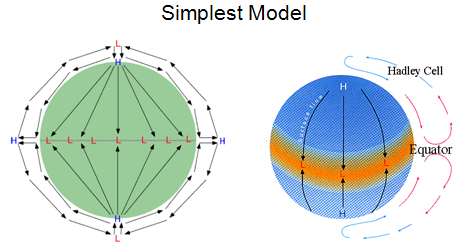
Common cold air, beingness more dumbo, sinks and hot air, being less dense, rises. Consequently, the rising warm air at the equator becomes even less dense every bit it rises and its pressure decreases. An area of low pressure, therefore, exists over the equator.
Warm air rises until it reaches a certain height at which it starts to spill over into surrounding areas. At the poles, the cold dense air sinks. Air from the upper levels of the atmosphere flows in on peak of it increasing the weight and creating an area of loftier pressure at the poles.
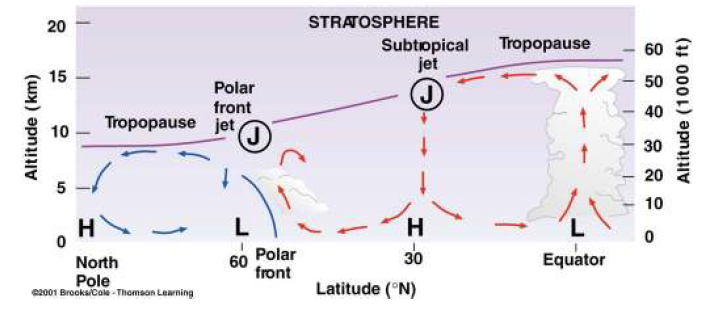
The air that rises at the equator does not flow directly to the poles. Due to the rotation of the earth, in that location is a build up of air at near 30° north latitude. (The same phenomenon occurs in the Southern Hemisphere). Some of the air sinks, causing a belt of high-pressure at this latitude.
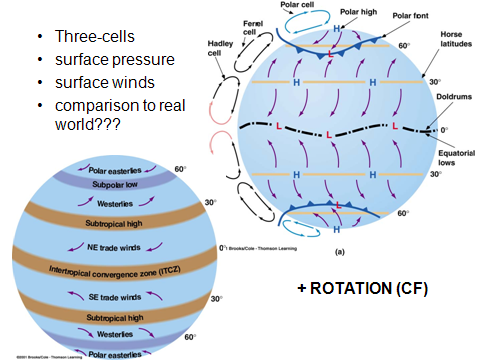
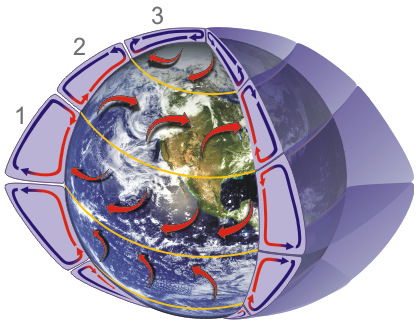
The sinking air reaches the surface and flows northward and southward. The air that flows south completes one cell of the earth's circulation blueprint. The air that flows north becomes part of another cell of circulation between 30° and 60° north latitude. At the same time, the sinking air at the north pole flows south and collides with the air moving n from the 30° high force per unit area area. The colliding air is forced upward and an area of depression pressure is created virtually lx° north. The third cell circulation pattern is created betwixt the north pole and 60° north.
Considering of the rotation of the earth and the coriolis force, air is deflected to the correct in the Northern Hemisphere. Equally a issue, the motion of air in the polar cell apportionment produces the polar easterlies. In the circulation cell that exists between 60° and 30° n, the movement of air produces the prevailing westerlies. In the tropic circulation cell, the northeast merchandise winds are produced. These are the so-called permanent wind systems of the each.
Since the earth rotates, the axis is tilted, and there is more land mass in the northern hemisphere than in the southern hemisphere, the actual global design is much more complicated. Instead of 1 large circulation between the poles and the equator, there are 3 circulations...
Hadley cell - Depression latitude air movement toward the equator that with heating, rises vertically, with poleward movement in the upper atmosphere. This forms a convection cell that dominates tropical and sub-tropical climates.
Ferrel jail cell - A mid-latitude hateful atmospheric circulation cell for weather named by Ferrel in the 19th century. In this cell the air flows poleward and eastward almost the surface and equatorward and due west at higher levels.
Polar cell - Air rises, diverges, and travels toward the poles. In one case over the poles, the air sinks, forming the polar highs. At the surface air diverges outward from the polar highs. Surface winds in the polar cell are easterly (polar easterlies).
UPPER LEVEL WINDS
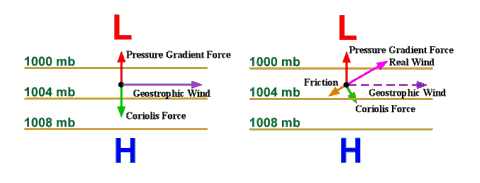
At that place are 2 main forces which affect the movement of air in the upper levels. The pressure gradient causes the air to move horizontally, forcing the air direct from a region of high pressure to a region of low pressure. The Coriolis force, however, deflects the direction of the flow of the air (to the right in the Northern Hemisphere) and causes the air to menstruum parallel to the isobars.
Winds in the upper levels will blow clockwise around areas of high force per unit area and counterclockwise effectually areas of low pressure.
The speed of the wind is adamant by the pressure level gradient. The winds are strongest in regions where the isobars are close together.
SURFACE WINDS
Surface friction plays an important role in the speed and management of surface winds. As a issue of the slowing downward of the air equally information technology moves over the footing, wind speeds are less than would be expected from the pressure gradient on the weather condition map and the management is changed so that the wind blows beyond the isobars into a center of depression pressure and out of a center of high pressure.
The effect of friction unremarkably does non extend more than a couple of g feet into the air. At 3000 feet above the ground, the wind blows parallel to the isobars with a speed proportional to the pressure level gradient.
Even allowing for the effects of surface friction, the winds, locally, practise non always show the speed and management that would be expected from the isobars on the surface weather map. These variations are unremarkably due to geographical features such as hills, mountains and big bodies of water. Except in mountainous regions, the upshot of terrain features that cause local variations in wind extends usually no college than about 2000 feet to a higher place the ground.
LAND AND SEA BREEZES
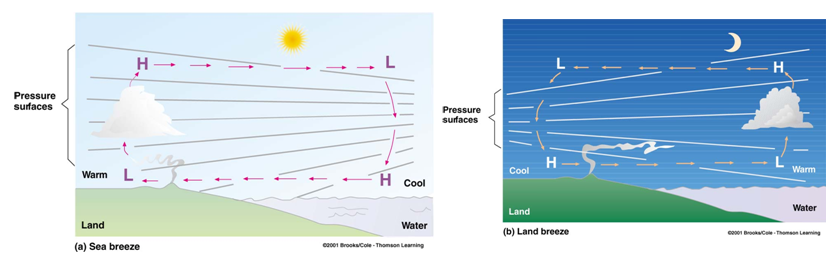
Land and sea breezes are caused by the differences in temperature over land and h2o. The sea breeze occurs during the twenty-four hours when the land area heats more than rapidly than the water surface. This results in the pressure over the land being lower than that over the h2o. The pressure gradient is oft stiff enough for a air current to blow from the water to the state.
The land breeze blows at night when the land becomes cooler. And then the wind blows towards the warm, low-force per unit area area over the h2o.
Country and ocean breezes are very local and affect but a narrow area forth the coast.
MOUNTAIN WINDS
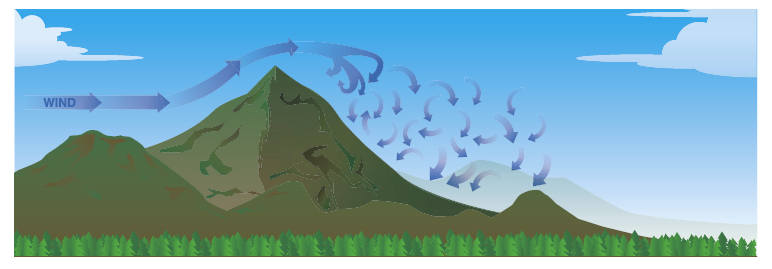
Hills and valleys substantially misconstrue the airflow associated with the prevailing force per unit area arrangement and the pressure gradient. Strong up and down drafts and eddies develop as the air flows up over hills and downwardly into valleys. Wind direction changes as the air flows around hills. Sometimes lines of hills and mountain ranges will human activity as a barrier, holding back the wind and deflecting it so that it flows parallel to the range. If there is a pass in the mountain range, the wind will rush through this pass as through a tunnel with considerable speed. The airflow can exist expected to remain turbulent and erratic for some distance as it flows out of the hilly surface area and into the flatter countryside.
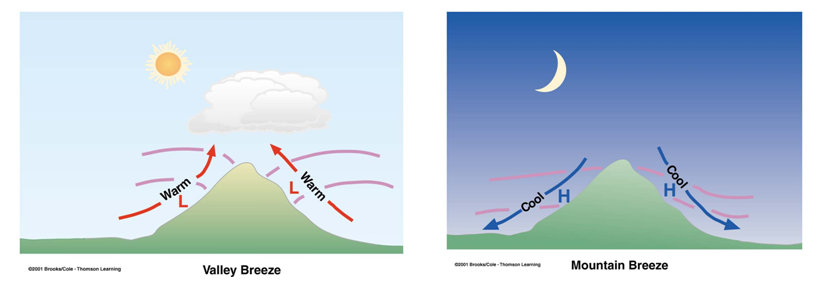
Daytime heating and nighttime cooling of the hilly slopes lead to day to night variations in the airflow. At nighttime, the sides of the hills cool past radiation. The air in contact with them becomes cooler and therefore denser and it blows down the slope into the valley. This is a katabatic wind (sometimes also called a mount cakewalk). If the slopes are covered with water ice and snow, the katabatic wind volition blow, not just at night, just also during the day, carrying the cold dumbo air into the warmer valleys. The slopes of hills not covered by snow volition be warmed during the twenty-four hours. The air in contact with them becomes warmer and less dense and, therefore, flows upwardly the slope. This is an anabatic wind (or valley breeze).
In mountainous areas, local baloney of the airflow is fifty-fifty more astringent. Rocky surfaces, high ridges, sheer cliffs, steep valleys, all combine to produce unpredictable flow patterns and turbulence.
THE Mountain WAVE
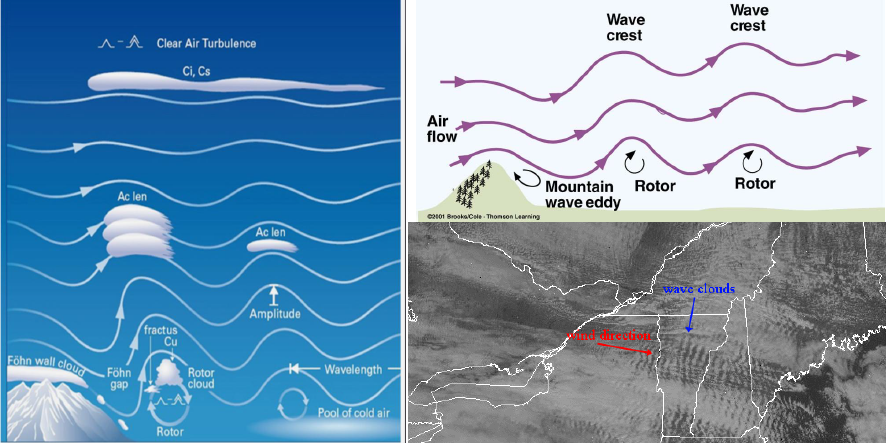
Air flowing across a mount range normally rises relatively smoothly upward the slope of the range, simply, in one case over the top, it pours downward the other side with considerable strength, bouncing upwards and downwards, creating eddies and turbulence and also creating powerful vertical waves that may extend for groovy distances downwind of the mount range. This miracle is known as a mountain wave. Notation the upwardly and downwardly drafts and the rotating eddies formed downstream.
If the air mass has a loftier moisture content, clouds of very distinctive advent will develop.
Cap Deject. Orographic lift causes a cloud to form along the top of the ridge. The air current carries this cloud down along the leeward slope where information technology dissipates through adiabatic heating. The base of this cloud lies near or below the peaks of the ridge; the top may accomplish a few chiliad anxiety higher up the peaks.
Lenticular (Lens Shaped) Cloudsform in the moving ridge crests aloft and lie in bands that may extend to well higher up xl,000 feet.
Rotor Cloudsgrade in the rolling eddies downstream. They resemble a long line of stratocumulus clouds, the bases of which prevarication beneath the mountain peaks and the tops of which may reach to a considerable acme above the peaks. Occasionally these clouds develop into thunderstorms.
The clouds, being very distinctive, can be seen from a great distance and provide a visible alert of the mount wave condition. Unfortunately, sometimes they are embedded in other cloud systems and are hidden from sight. Sometimes the air mass is very dry and the clouds do non develop.
The severity of the mountain wave and the top to which the disturbance of the air is affected is dependent on the forcefulness of the wind, its angle to the range and the stability or instability of the air. The most severe mountain wave conditions are created in strong airflows that are blowing at right angles to the range and in stable air. A jet stream bravado virtually perpendicular to the mount range increases the severity of the wave condition.
The mountain moving ridge miracle is not limited only to high mountain ranges, such every bit the Rockies, but is also nowadays to a lesser degree in smaller mountain systems and even in lines of small hills.
Mount waves nowadays problems to pilots for several reasons:
Vertical Currents. Downdrafts of 2000 anxiety per minute are common and downdrafts equally groovy as 5000 feet per infinitesimal take been reported. They occur along the downwards slope and are nigh severe at a superlative equal to that of the elevation. An airplane, defenseless in a downdraft, could be forced to the basis.
Turbulence is usually extremely severe in the air layer between the ground and the tops of the rotor clouds.
Wind Shear. The wind speed varies dramatically between the crests and troughs of the waves. It is commonly most astringent in the wave nearest the mount range.
Altimeter Error. The increase in wind speed results in an accompanying decrease in force per unit area, which in turn affects the accuracy of the pressure altimeter.
Icing. The freezing level varies considerably from crest to trough. Astringent icing tin can occur because of the large supercooled droplets sustained in the stiff vertical currents.
When flight over a mount ridge where wave conditions be:
(1) Avert ragged and irregular shaped clouds—the irregular shape indicates turbulence. (2) Approach the mountain at a 45-degree angle. It you should suddenly decide to turn dorsum, a quick turn tin be made abroad from the high ground. (three) Avert flying in deject on the mountain crest (cap cloud) because of potent downdrafts and turbulence. (4) Allow sufficient height to clear the highest ridges with altitude to spare to avoid the downdrafts and eddies on the downwind slopes. (5) Always remember that your altimeter can read over 3000 ft. in error on the loftier side in mountain wave weather.
GUSTINESS
A gust is a rapid and irregular fluctuation of varying intensity in the upwards and downwardly movement of air currents. It may be associated with a rapid change in current of air management. Gusts are caused past mechanical turbulence that results from friction betwixt the air and the footing and by the diff heating of the world's surface, especially on hot summer afternoons.
SQUALLS
A squall is a sudden increase in the strength of the current of air of longer duration than a gust and may exist caused past the passage of a fast moving cold front or thunderstorm. Like a gust, information technology may exist accompanied by a rapid modify of wind direction.
DIURNAL VARIATIONS
Diurnal (daily) variation of air current is caused by strong surface heating during the twenty-four hour period, which causes turbulence in the lower levels. The result of this turbulence is that the direction and speed of the wind at the higher levels (due east.g., 3000 feet) tends to exist transferred to the surface. Since the wind management at the higher level is parallel to the isobars and its speed is greater than the surface wind, this transfer causes the surface wind to veer and increase in speed.
At nighttime, there is no surface heating and therefore less turbulence and the surface wind tends to resume its normal direction and speed. Information technology backs and decreases. Run across VEERING AND Bankroll section below for more info.
EDDIES—MECHANICAL TURBULENCE
Friction between the moving air mass and surface features of the earth (hills, mountains, valleys, copse, buildings, etc.) is responsible for the swirling vortices of air commonly called eddies. They vary considerably in size and intensity depending on the size and roughness of the surface obstruction, the speed of the wind and the caste of stability of the air. They can spin in either a horizontal or vertical plane. Unstable air and stiff winds produce more vigorous eddies. In stable air, eddies tend to quickly dissipate. Eddies produced in mountainous areas are particularly powerful.
The bumpy or inclement up and downwardly motion that signifies the presence of eddies makes it difficult to continue an airplane in level flight.
DUST DEVILS
Grit devils are phenomena that occur quite frequently on the hot dry plains of mid-western North America. They can be of sufficient force to present a hazard to pilots of light airplanes flying at low speeds.
They are pocket-size rut lows that form on articulate hot days. Given a steep lapse rate caused by absurd air aloft over a hot surface, trivial horizontal air motility, few or no clouds, and the noonday sun heating flat barren soil surfaces to high temperatures, the air in contact with the ground becomes super-heated and highly unstable. This surface layer of air builds until something triggers an upwardly motion. Once started, the hot air rises in a column and draws more hot air into the base of the cavalcade. Circulation begins around this heat low and increases in velocity until a small vigorous whirlwind is created. Dust devils are unremarkably of brusk duration and are and then named considering they are made visible by the dust, sand and debris that they option up from the basis.
Dust devils pose the greatest hazard nigh the basis where they are most violent. Pilots proposing to land on superheated runways in areas of the mid-west where this miracle is mutual should scan the airport for grit swirls or grass spirals that would indicate the beingness of this chance.
TORNADOES
Tornadoes are vehement, round whirlpools of air associated with severe thunderstorms and are, in fact, very deep, concentrated low-pressure areas. They are shaped like a tunnel hanging out of the cumulonimbus cloud and are dark in appearance due to the grit and debris sucked into their whirlpools. They range in bore from about 100 feet to one half mile and move over the ground at speeds of 25 to fifty knots. Their path over the ground is unremarkably only a few miles long although tornadoes have been reported to cut destructive swaths equally long every bit 100 miles. The bully destructiveness of tornadoes is acquired by the very low pressure level in their centers and the high air current speeds, which are reputed to be as great equally 300 knots.
WIND SPEEDS AND Management
Current of air speeds for aviation purposes are expressed in knots (nautical miles per 60 minutes). In the atmospheric condition reports on U.s. public radio and tv, however, air current speeds are given in miles per hr while in Canada speeds are given in kilometers per hour.
In a discussion of wind management, the compass point from which the air current is blowing is considered to exist its management. Therefore, a north wind is one that is bravado from the north towards the south. In aviation weather reports, area and aerodrome forecasts, the wind is always reported in degrees true. In ATIS broadcasts and in the information given past the tower for landing and take-off, the wind is reported in degrees magnetic.
VEERING AND BACKING
The wind veers when it changes direction clockwise. Example: The surface wind is bravado from 270°. At 2000 feet it is blowing from 280°. It has inverse in a right-manus, or clockwise, direction.
The current of air backs when it changes direction anti-clockwise. Case: The wind direction at 2000 feet is 090° and at 3000 feet is 085°. It is irresolute in a left-hand, or anti-clockwise, direction.
In a descent from several m feet in a higher place the ground to basis level, the wind will unremarkably be institute to back and also decrease in velocity, as the effect of surface friction becomes apparent. In a climb from the surface to several thousand feet AGL, the air current volition veer and increment.
At dark, surface cooling reduces the eddy movement of the air. Surface winds will back and decrease. Conversely, during the day, surface heating increases the eddy motion of the air. Surface winds volition veer and increment every bit stronger winds aloft mix to the surface. Meet DIURNAL VARIATIONS section higher up for more info.
Wind SHEAR
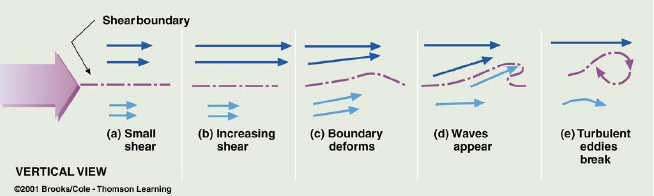
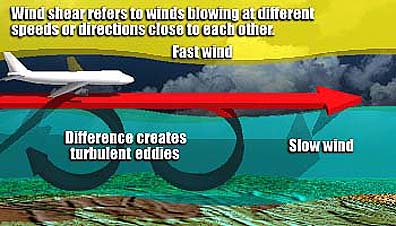
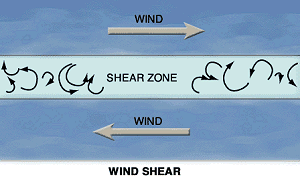
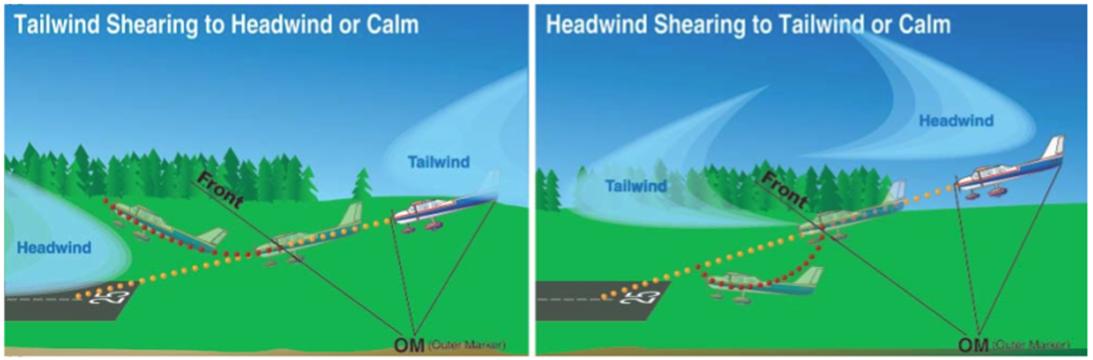
Current of air shear is the sudden tearing or shearing effect encountered along the edge of a zone in which at that place is a violent change in current of air speed or direction. It can exist in a horizontal or vertical direction and produces churning motions and consequently turbulence. Under some conditions, wind management changes of as much as 180 degrees and speed changes of as much as 80 knots have been measured.
The consequence on airplane functioning of encountering wind shear derives from the fact that the air current can change much faster than the aeroplane mass tin exist accelerated or decelerated. Severe wind shears can impose penalties on an airplane's performance that are across its capabilities to compensate, particularly during the critical landing and take-off phase of flight.
In Cruising Flight
In cruising flying, air current shear will likely be encountered in the transition zone between the force per unit area gradient current of air and the distorted local winds at the lower levels. It volition likewise be encountered when climbing or descending through a temperature inversion and when passing through a frontal surface. Current of air shear is also associated with the jet stream. Airplanes encountering wind shear may experience a succession of updrafts and downdrafts, reductions or gains in headwind, or windshifts that disrupt the established flight path. It is non commonly a major trouble because distance and airspeed margins will be adequate to counteract the shear's agin effects. On occasion, however, the wind shear may be severe enough to cause an abrupt increment in load factor, which might stall the aeroplane or inflict structural damage.
Near the Footing
Wind shear, encountered near the ground, is more serious and potentially very dangerous. In that location are iv common sources of depression level wind shear: thunderstorms, frontal activity, temperature inversions and potent surface winds passing around natural or manmade obstacles.
Frontal Wind Shear. Air current shear is usually a problem only in fronts with steep wind gradients. If the temperature difference across the front at the surface is five°C or more and if the front is moving at a speed of nigh 30 knots or more, wind shear is probable to exist present. Frontal wind shear is a miracle associated with fast moving common cold fronts just can be present in warm fronts equally well.
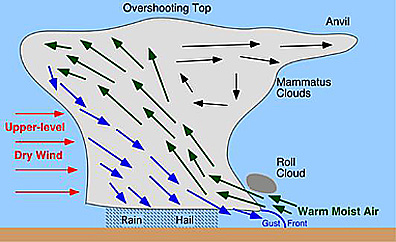
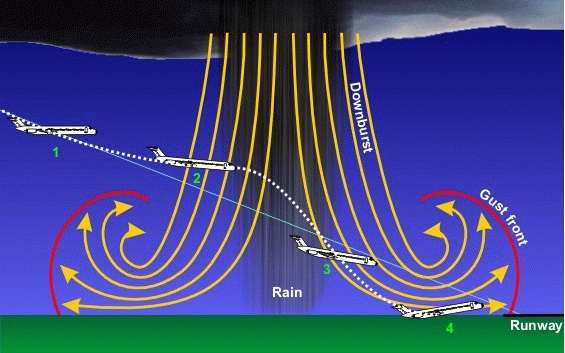
Thunderstorms. Wind shear, associated with thunderstorms, occurs as the consequence of two phenomena, the gust front and downbursts. As the thunderstorm matures, strong downdrafts develop, strike the footing and spread out horizontally along the surface well in accelerate of the thunderstorm itself. This is the gust front. Winds can change direction by as much as 180° and attain speeds as bully every bit 100 knots as far every bit ten miles ahead of the storm. The downburst is an extremely intense localized downdraft flowing out of a thunderstorm. The ability of the downburst tin exceed shipping climb capabilities. The downburst (there are ii types of downbursts: macrobursts and microbursts) usually is much closer to the thunderstorm than the gust front. Dust clouds, roll clouds, intense rainfall or virga (rain that evaporates before it reaches the ground) are due to the possibility of downburst activity but in that location is no way to accurately predict its occurrence.
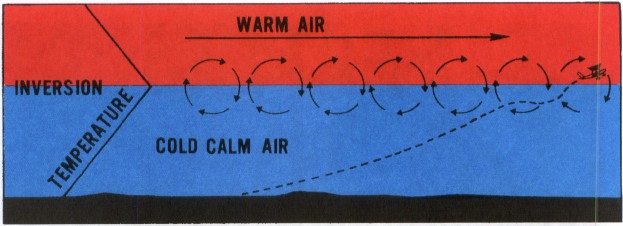
Temperature Inversions. Overnight cooling creates a temperature inversion a few hundred anxiety above the footing that can produce significant wind shear, particularly if the inversion is coupled with the depression-level jet stream.
Equally a nocturnal inversion develops, the wind shear near the pinnacle of the inversion increases. It usually reaches its maximum speed shortly after midnight and decreases in the forenoon as daytime heating dissipates the inversion. This miracle is known as the low-level nocturnal jet stream. The low level jet stream is a sheet of potent winds, thousands of miles long, hundreds of miles wide and hundreds of feet thick that forms over apartment terrain such every bit the prairies. Current of air speeds of 40 knots are common, just greater speeds have been measured. Depression level jet streams are responsible for chancy depression level shear.
As the inversion dissipates in the forenoon, the shear plane and gusty winds move closer to the basis, causing windshifts and increases in wind speed near the surface.
Surface Obstructions. The irregular and turbulent flow of air around mountains and hills and through mount passes causes serious air current shear problems for aircraft budgeted to land at airports well-nigh mount ridges. Wind shear is a phenomenon associated with the mount wave. Such shear is almost totally unpredictable but should be expected whenever surface winds are strong.
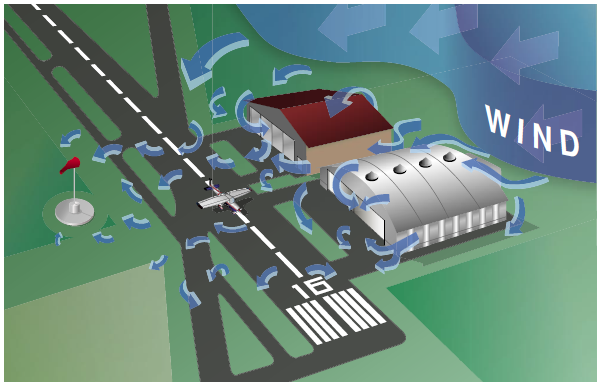
Wind shear is also associated with hangars and large buildings at airports. As the air flows around such large structures, wind direction changes and wind speed increases causing shear.
Air current shear occurs both horizontally and vertically. Vertical shear is nigh common near the footing and can pose a serious hazard to airplanes during have-off and landing. The aeroplane is flying at lower speeds and in a relatively high elevate configuration. There is little distance bachelor for recovering and stall and maneuver margins are at their lowest. An airplane encountering the wind shear miracle may feel a big loss of airspeed because of the sudden change in the relative airflow as the airplane flies into a new, moving air mass. The abrupt drop in airspeed may outcome in a stall, creating a unsafe situation when the airplane is just a few hundred feet off the ground and very vulnerable.
THE JET STREAM
Narrow bands of exceedingly high speed winds are known to be in the higher levels of the atmosphere at altitudes ranging from 20,000 to 40,000 feet or more. They are known as jet streams. Equally many every bit 3 major jet streams may traverse the N American continent at any given time. I lies across Northern Canada and i across the U.Due south. A third jet stream may exist equally far south as the northern tropics but information technology is somewhat rare. A jet stream in the mid latitudes is generally the strongest.
The jet stream appears to be closely associated with the tropopause and with the polar front. It typically forms in the break between the polar and the tropical tropopause where the temperature gradients are intensified. The hateful position of the jet stream shears south in winter and n in summertime with the seasonal migration of the polar front. Because the troposphere is deeper in summer than in winter, the tropopause and the jets will nominally be at higher altitudes in the summer.
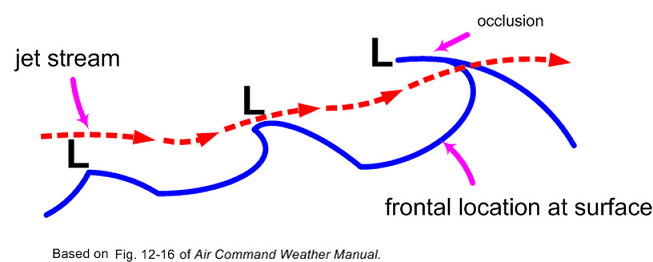
Long, stiff jet streams are usually besides associated with well-developed surface lows below deep upper troughs and lows. A low developing in the moving ridge along the frontal surface lies south of the jet. As it deepens, the depression moves near the jet. As it occludes, the low moves n of the jet, which crosses the frontal system, near the point of occlusion. The jet flows roughly parallel to the front end. The subtropical jet stream is not associated with fronts but forms because of strong solar heating in the equatorial regions. The ascending air turns poleward at very loftier levels but is deflected by the Coriolis force into a strong westerly jet. The subtropical jet predominates in wintertime.
The jet streams catamenia from west to e and may encircle the entire hemisphere. More frequently, considering they are stronger in some places than in others, they break up into segments some g to 3000 nautical miles long. They are ordinarily about 300 nautical miles broad and may be 3000 to 7000 feet thick. These jet stream segments motion in an easterly direction following the movement of pressure ridges and troughs in the upper atmosphere.
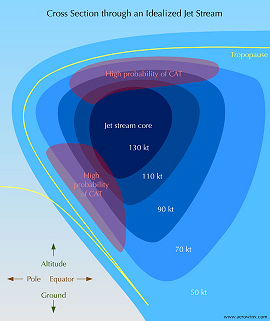
Winds in the fundamental core of the jet stream are the strongest and may reach speeds as slap-up as 250 knots, although they are mostly between 100 and 150 knots. Current of air speeds subtract toward the outer edges of the jet stream and may exist blowing at only 25 knots there. The rate of decrease of wind speed is considerably greater on the northern edge than on the southern edge. Air current speeds in the jet stream are, on average, considerably stronger in winter than in summer.
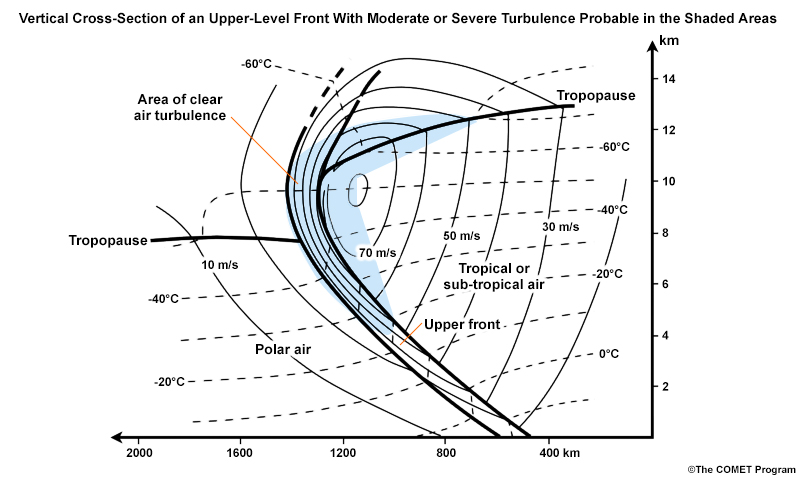
Articulate Air Turbulence. The virtually likely place to expect Clear Air Turbulence (True cat) is just to a higher place the central cadre of the jet stream near the polar tropopause and simply below the core. Clear air turbulence does not occur in the core. True cat is encountered more than ofttimes in winter when the jet stream winds are strongest. Nevertheless, True cat is non always present in the jet stream and, because it is random and transient in nature, it is almost impossible to forecast.
Clear air turbulence may be associated with other weather patterns, especially in wind shear associated with the sharply curved contours of potent lows, troughs and ridges aloft, at or below the tropopause, and in areas of potent cold or warm air advection. Mountain waves create severe True cat that may extend from the mountain crests to every bit high as 5000 feet above the tropopause. Since severe CAT does pose a take a chance to airplanes, pilots should endeavor to avert or minimize encounters with it. These rules of thumb may assist avert jet streams with strong winds (150 knots) at the core. Strong wind shears are likely above and below the core. CAT within the jet stream is more than intense above and to the lee of mount ranges. If the 20-knot isotachs (lines joining areas of equal air current speeds) are closer than 60 nautical miles on the charts showing the locations of the jet stream, wind shear and CAT are possible.
Curving jet streams are probable to have turbulent edges, especially those that curve around a deep pressure trough. When moderate or severe CAT has been reported or is forecast, adjust speed to rough air speed immediately on encountering the beginning bumpiness or fifty-fifty before encountering it to avoid structural impairment to the airplane.
The areas of Cat are normally shallow and narrow and elongated with the wind. If jet stream turbulence is encountered with a tail wind or head wind, a turn to the right volition detect smoother air and more favorable winds. If the True cat is encountered in a crosswind, it is not so important to change form as the rough area will be narrow.
0 Response to "How Can Surface Winds Help You Know When a Typical"
Post a Comment